July and August are when most people sail in Greece. They are not, for most crews, the best time to sail in Greece, and the difference between those two statements is worth a few minutes of your planning.
The season runs from April to October and the conditions across it change more than the brochures suggest. Wind, heat, sea temperature and how many other boats are in the bay all move month by month, and the month that suits a family with young children is not the month that suits two sailors who want a proper breeze.
Here is what each part of the season is actually like.
The season
April to October is the sailing season in Greece. Outside it the fleets are hauled out, most bases are closed and the weather turns Mediterranean-winter rather than Mediterranean-holiday.
Within the season there are effectively three periods. The shoulder months at each end are quiet and mild, the high summer in the middle is hot, busy and windy in the Aegean, and there is a short transitional window either side of it where you get the best of both.
The single biggest variable is the wind, and it behaves differently in the two seas. The Ionian has a gentle northwesterly sea breeze that fills in through the afternoon and dies at night, all season. The Aegean has that plus the meltemi, a northerly wind that can blow hard for days at a time in high summer.
| Month | Wind | Heat and sea | Crowds |
|---|---|---|---|
| April | Variable, occasional fronts | Mild days, cool nights, cold sea | Very quiet |
| May | Light to moderate, settled | Warm days, sea still cool | Quiet |
| June | Steady breeze, meltemi beginning | Warm, long days, sea comfortable | Filling up |
| July | Meltemi established in the Aegean | Hot | Busy |
| August | Meltemi at its strongest | Peak heat, as in July | Busiest |
| September | Easing through the month | Warm, sea still at summer temperatures | Thinning |
| October | Lighter, more variable, rain possible | Mild, sea still warm | Very quiet |
April and May
The season opens in April. The islands are green from the winter rain, the wild flowers are out, the harbours are empty and you can tie up anywhere without thinking about it.
The trade-off is the water and the weather. The sea is still cold in April and only just swimmable by late May, and the weather is more changeable than later in the year, with the occasional front coming through. Evenings need a jumper.
May is the better of the two. The days are properly warm, the wind is generally light to moderate and settled, and everything ashore has opened for the season without filling up. For anyone who wants Greece without the crowds and does not mind a brisk swim, it is one of the best months of the year.
Both months suit sailors more than swimmers. If the holiday is built around the water rather than the sailing, wait.
June
June is, for a lot of crews, the sweet spot. The days are long, the weather has settled into its summer pattern, the sea has warmed up enough to swim without thinking about it and the harbours are busy without being full.
The wind is reliable rather than strong. In the Ionian the afternoon breeze does exactly what it does all season. In the Aegean the meltemi is beginning to establish itself but is not yet at full strength, which gives you real sailing without the days-on-end pattern of high summer.
It is also the last month before the school holidays hit, which shows in the anchorages. By the end of June the difference is already noticeable.
July and August
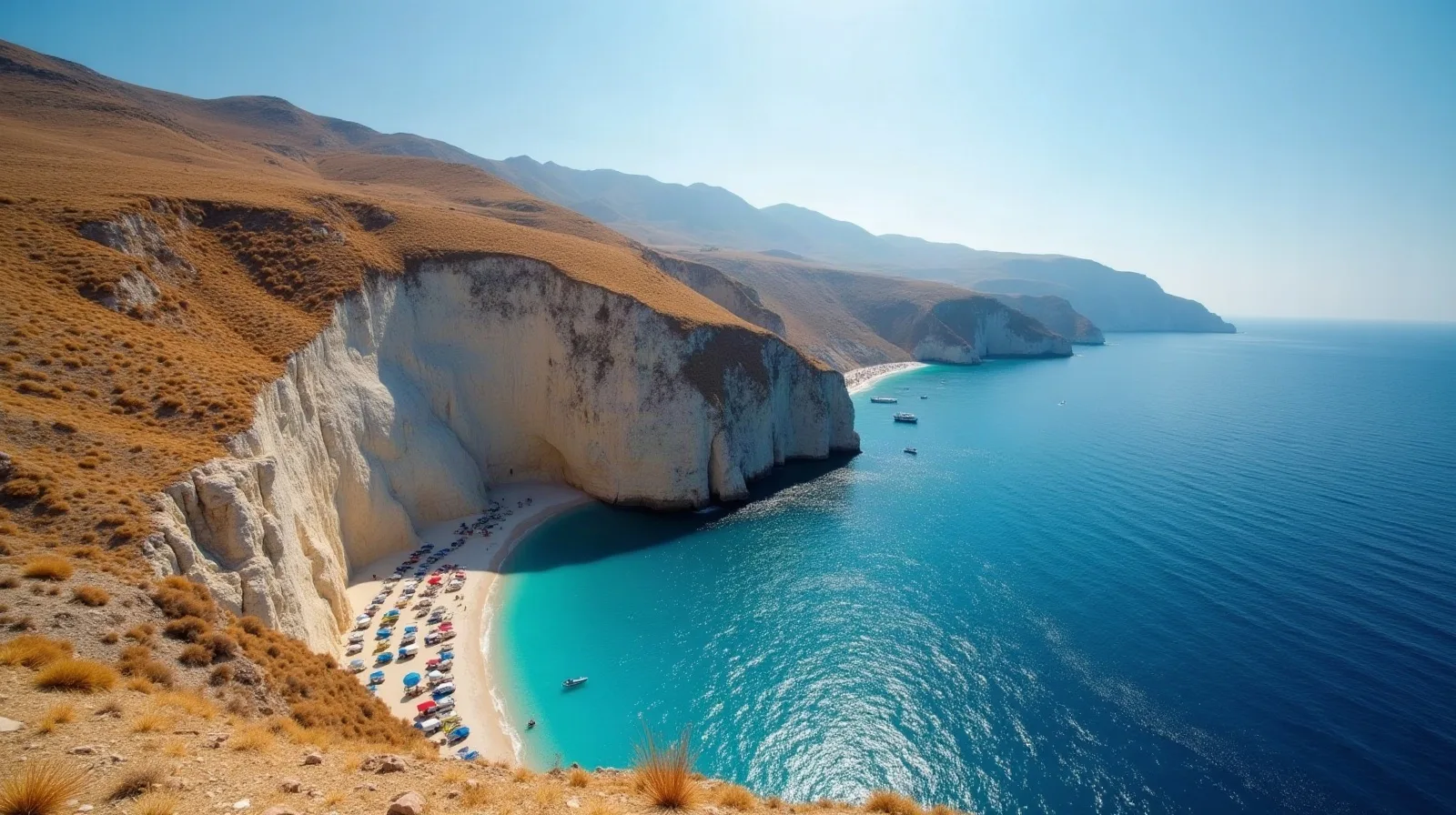
These are the busiest and hottest weeks of the year, and in the Aegean the windiest. Ashore it is properly hot, harbours fill by early evening and popular bays have several boats in them by lunchtime.
The meltemi is the defining feature. It blows from the north across the Aegean, is at its strongest in these two months, and can run for several days without a break. For an experienced crew it is superb, fast sailing. For an inexperienced one it can turn a week into a series of long, uncomfortable passages, which is why so many Cyclades charters in high summer are taken with a skipper. It is the single biggest reason the Cyclades are a region for experienced crews in high summer.
The Ionian is a different story in the same weeks. It sits largely outside the meltemi’s reach, so July and August there are hot and busy but not windy, which is why families cluster in that sea in the school holidays.
If your dates are fixed to these weeks, choose the region accordingly rather than fighting the weather.
September and October
September is the month experienced charterers keep to themselves. The sea is still warm after a summer of heating up, the air is still hot but no longer punishing, the meltemi eases through the month and the crowds thin week by week.
By late September the harbours have space again, restaurants are relaxed and the light is better than at any other point in the season. It is the closest thing to having the good weather without the summer.
October keeps the warm sea and adds a gentler pace. Days are shorter, the chance of rain increases as the month goes on and the wind becomes lighter and less predictable, but for a quiet week on a warm sea it is excellent value and the anchorages are empty.
Both months reward flexibility. Weather in the shoulder season is less locked into a pattern, so checking the forecast properly matters more than it does in July. What to watch for when the weather turns is covered in our Travel Aware notes.
Choosing your month
Work from what the week is for.
If it is about swimming and warm water, take September first and June second. If it is about sailing, June and September again, with July and August in the Aegean for crews who want the meltemi rather than tolerate it. If it is about quiet harbours and cost, take May or October and accept a cooler sea.
If you have children in school, your dates are chosen for you. In that case pick the region rather than the month: the Ionian and the Saronic in July and August are hot and busy but sheltered, and that combination works far better with a family on board than the open Aegean does.
And if you are choosing between two months and cannot decide, take the later one. September in Greece rarely disappoints anyone.
One practical consequence of all this: the shoulder months reward a flexible plan more than a fixed one. Weather in May and October moves around rather than settling into a pattern, so a week with a spare day in it is worth considerably more than a week with a fixed route.
For local conditions by base, see our guides to Corfu, Lefkada, Mykonos and Santorini.
Frequently Asked Questions
When is the best time to sail in Greece?
May, June, September and October offer excellent weather with fewer crowds. September is the strongest single month for most crews: warm sea, easing wind and quiet harbours.
When is the sailing season in Greece?
April to October. Outside those months most charter bases are closed and the fleets are out of the water.
Is August a bad time to sail?
Not bad, but demanding. With July, it is the hottest and busiest time of year, and in the Aegean the meltemi is at its strongest. The Ionian and the Saronic are the sheltered choices for those weeks.
When is the sea warmest?
In high summer. Sea temperatures peak in late July and early August, and the water stays warm through September and well into October.
Which month is quietest?
April and October at the two ends of the season, with empty anchorages and harbours you can tie up in without planning ahead.
Sources
- Encyclopaedia Britannica, Etesian wind. https://www.britannica.com/science/etesian-wind
- SKYbrary Aviation Safety, Etesian Wind. https://skybrary.aero/articles/etesian-wind
- Encyclopaedia Britannica, Greece, Climate. https://www.britannica.com/place/Greece/Climate
- Eurostat, Seasonality in the tourist accommodation sector. https://ec.europa.eu/eurostat/statistics-explained/index.php/Seasonality_in_the_tourist_accommodation_sector
- Journal of Marine Science and Engineering, Sea Surface Temperature Variability and Marine Heat Waves over the Aegean, Ionian, and Cretan Seas from 2008-2021. https://mdpi-res.com/d_attachment/jmse/jmse-10-00042/article_deploy/jmse-10-00042.pdf
Send us your dates and the size of your group and we will tell you what those weeks are actually like on the water, and what is free in them.
Send your dates and group size