Short answer
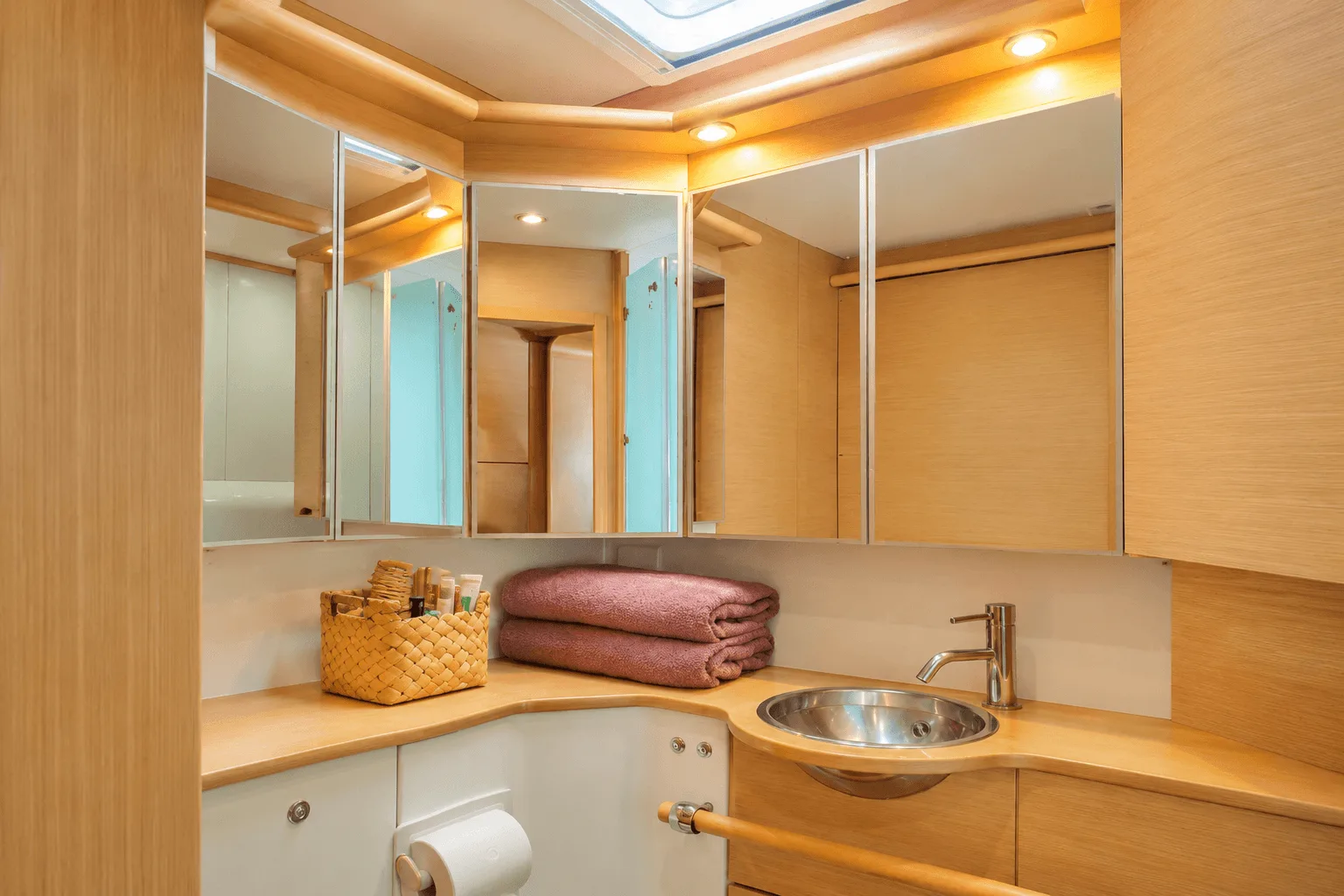
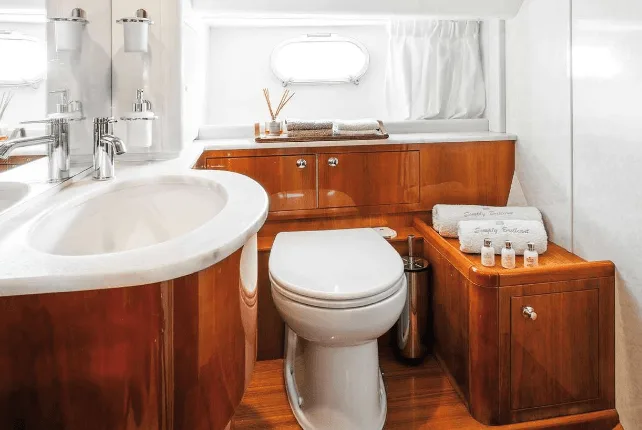
How do boat toilets work? On most charter yachts the toilet is a manual marine toilet. A small lever lets sea water into the bowl, and a hand pump pushes everything out through a pipe, either into a holding tank on board or out through the hull. Electric toilets do the same job at the press of a button.
The difference from a toilet at home is that nothing happens by itself. You pump, the lever decides whether water comes in, and you decide what goes into the bowl. Those three habits are most of what anyone on board needs to know.
On a bareboat yacht charter in Greece the toilets are part of the yacht you look after for the week. On a skippered or crewed yacht someone on board knows the system, and the routine below is all you need.
How does the hand pump work?
A manual marine toilet has a pump handle beside the bowl and a small flush lever. With the lever open, every stroke brings water into the bowl and pumps the contents out. With the lever shut, the pump only empties the bowl and adds no water.
The flush is a short sequence rather than a single button, and it takes a minute to learn.
| Step | Lever | What you do |
|---|---|---|
| Before use | Open | Pump until there is some water in the bowl, so that paper does not compact, then shut the lever |
| Empty the bowl | Shut | Pump until the bowl is empty |
| Clear the pipe | Open | Keep pumping until everything has left the pipe, allowing about seven full strokes for every metre of pipe |
| Finish | Shut | Pump the bowl dry and leave it empty, which keeps smells down |
Long, smooth strokes work better than short, fast ones. The longer the pipe from the toilet to the tank or the hull, the more strokes it needs, so if you are not sure, give it more strokes rather than fewer. Clearing the pipe properly and leaving the bowl empty is also what keeps smells down.
If the yacht has more than one toilet, learn the routine on each of them on the first day. Ask someone to show you the lever positions rather than working them out alone.
Each toilet also has seacocks, valves on the water inlet and on the outlet through the hull. The manufacturer’s instructions say both should be shut after use and whenever the yacht is left unattended, because the flush lever is not a shut-off valve. On a charter, follow the routine you are given for that yacht. At the handover described in what a bareboat charter actually involves, the base walks you through the seacocks and through-hull fittings, which is the moment to ask about the toilets too.
What can go down a boat toilet?
Only what you have eaten, plus a little toilet paper. Everything else goes in the bin, because anything else can block the pump and the pipe behind it.
The list of things that must never go in is short and worth reading out to everyone on the first evening:
- wet wipes and wet-strength tissues
- sanitary products and cotton wool
- cigarettes, matches and chewing gum
- any solid object, however small
- fuel, oil, solvents or very hot water
Ordinary household toilet paper is fine in small amounts. If the briefing on your yacht asks for paper to go in the bin instead, follow that. Children need the same short lesson as adults, and our guide to chartering with children covers the other house rules that make a family week easier.
Where does the waste go?
Either into a holding tank on board or straight out through the hull, depending on how the yacht is plumbed and how its valves are set. In Greece, the rules on discharges and pollution make a holding tank a practical necessity, so in harbours, marinas and anchorages the waste should go into the tank.
The tank is emptied later, out at sea and well away from the coast, swimmers and other boats, or at a marina pump-out where one is available. Nobody wants to swim in a bay where a toilet has just been emptied.
If you are not sure how the valves are set, ask before you use the toilet in a harbour, not after. It takes a minute to check and saves an awkward conversation on the quay.
On a skippered yacht charter in Greece, leave the valves and the timing to the skipper. On a bareboat, ask at the handover where the tank valve is, which position sends waste to the tank and how you will know when it needs emptying.
On a crewed yacht charter in Greece, the crew run the system and the only thing asked of guests is what goes into the bowl.
What about electric toilets?
An electric toilet does the pumping for you. A button or a touch panel starts a pump that breaks up the waste and carries it away, then rinses the bowl.
Some models offer more than one flush setting, with a short flush that uses about one litre of water and a normal flush of about two. Depending on how the toilet is fitted, the rinse water is either sea water or fresh water from the yacht’s own tanks, and in the second case every flush comes out of the water you fill at the quay.
The rule on what goes into the bowl does not change with an electric toilet, and neither does the habit of telling someone as soon as it stops working properly.
What if it blocks or smells?
If the handle becomes hard to move or the bowl will not empty, stop pumping and ask for help rather than forcing it. On a skippered yacht that means the skipper. On a bareboat it means calling the base, because technical assistance is part of the charter and support is available around the clock.
Do not try to take the pump apart yourself. On a charter yacht the repair belongs to the base or the skipper, and a fault reported early is easier to settle than one found at the end of the week.
Smells are best prevented with the same two habits as blockages: leave the bowl empty after every use and give the pipe enough strokes to clear it.
Five habits that keep the toilets working
- Water in the bowl first, so paper does not compact.
- Nothing you have not eaten, apart from a little paper.
- Enough strokes to clear the whole pipe, not just the bowl.
- Bowl left empty with the lever shut after every use.
- Report a problem early, before it becomes a blocked toilet for the rest of the week.
A smell that stays after all of that is a fault worth reporting, not something to live with for a week.
Frequently Asked Questions
Do boat toilets flush into the sea?
Some do, straight out through a valve in the hull, but a yacht with a holding tank can store the waste instead. In Greek harbours, marinas and anchorages the waste should go into the tank, which is emptied later, well out at sea or at a marina pump-out.
How do you flush a boat toilet?
On a manual toilet, shut the lever and pump the bowl empty, open the lever and keep pumping to clear the pipe, then shut it again and pump the bowl dry. Allow about seven full strokes for every metre of pipe.
How do you empty a boat toilet?
The bowl is emptied by pumping. The holding tank is emptied by setting its valve once the yacht is well out at sea and away from the coast, or at a marina pump-out. On a skippered charter, ask the skipper.
How do you stop a marine toilet from smelling?
Leave the bowl empty after every use, pump enough strokes to clear the whole pipe and put nothing in it except what you have eaten and a little paper. If a smell stays, report it to the skipper or the base.
Sources
- Jabsco, Manual toilets: installation and operating instructions. https://sailing.mit.edu/wikiupload/7/7b/Jabsco_29090_29120_toilets_0406_data_sheet.pdf
- Royal Yachting Association, Holding tanks. https://www.rya.org.uk/boating-abroad/holding-tanks/
- Xylem, Jabsco Quiet Flush QC Series technical data sheet. https://toplicht.imgbolt.de/media/78/69/1a/1731714205/4600-016%20TDS-EN.pdf
Send us your dates and the size of your group, and we will come back with the bareboat yachts that are actually available, with their exact specifications and a written quotation.
Send your dates for a bareboat quote