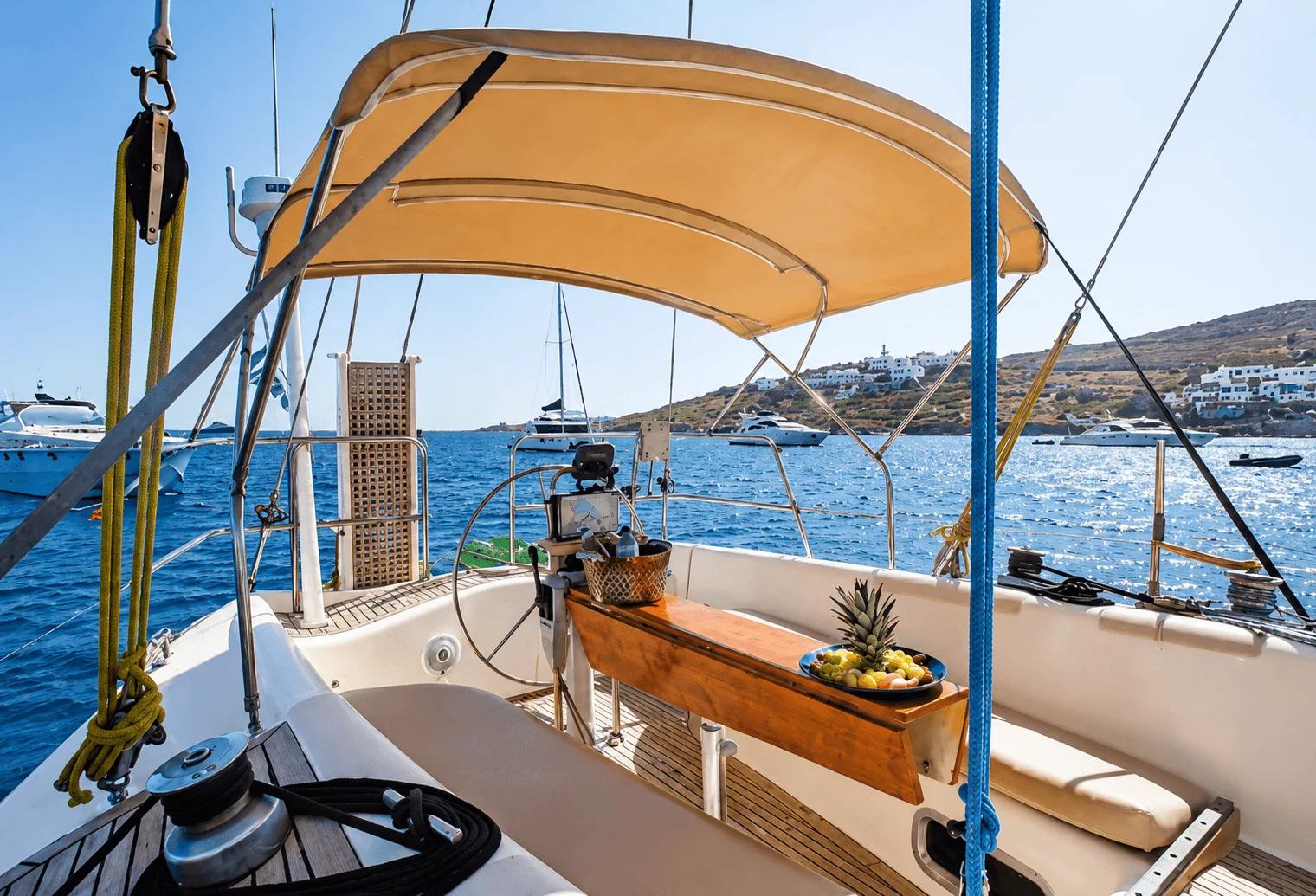
Two ways to learn
There are two ways to learn to sail in Greece. One is a recognised sailing course, run by a training centre, which ends with a certificate. The other is a skippered charter, where a professional sails the yacht and teaches you as much as you want to learn along the way, without a certificate at the end.
The two answer different questions. A course is the route if your goal is to charter a yacht yourselves one day. A skippered week is the route if your goal is a holiday at sea with a skipper alongside, and the chance to take the helm and handle the sails while someone experienced watches.
The two also work well together. A skippered week tells you whether you enjoy life on a yacht before you commit to a course, and a course makes the next skippered week more interesting because you understand what the skipper is doing.
A recognised sailing course
A recognised course follows a national training scheme, with a syllabus, a set length and a certificate at the end. A scheme taught in English is that of the Royal Yachting Association, the British national body, whose list of training centres includes one on Aegina in the Saronic Gulf.
For someone starting from nothing, the scheme offers two first steps: a two-day Start Yachting introduction and the five-day Competent Crew course. Competent Crew needs no previous experience, and it is aimed at people who want to become active crew rather than passengers. You live aboard for the week and learn to steer, change sails, reef and tie the knots that matter, together with the safety basics such as what to do if someone falls overboard.
The next step is the Day Skipper practical course, which teaches you to take charge of a yacht and its crew on day trips in familiar waters. It is a skipper’s course, not a beginner’s one, and it has entry requirements in time at sea and theory knowledge, set out below.
On both practical courses you live on board with the instructor and the other students, so the week is also a lesson in sharing a small space and running a yacht day to day.
Whichever course you choose, the certificate is what counts later. Course completion certificates can be used as evidence of your competence when you charter a yacht yourself.
Learning on a skippered charter
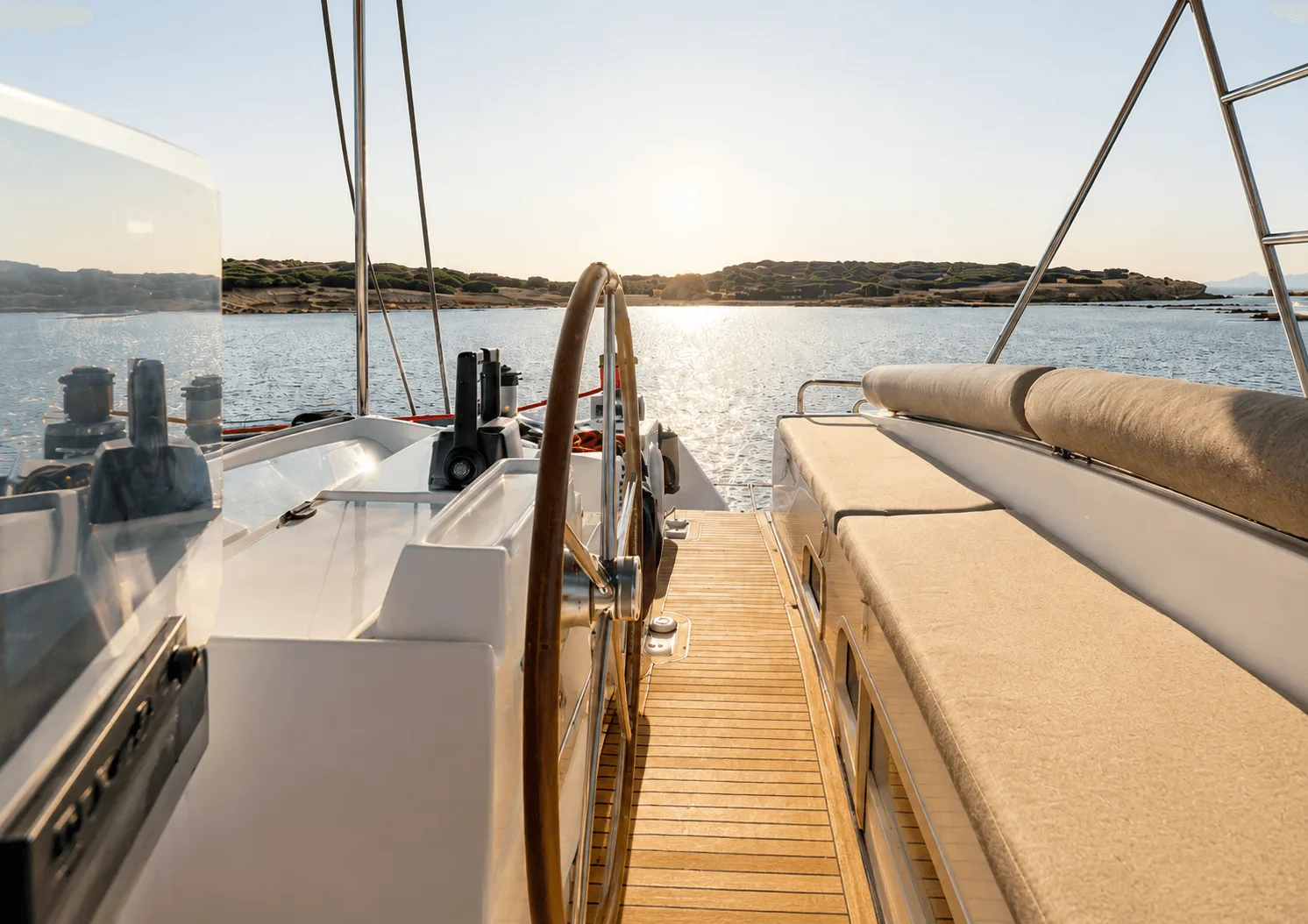
On a skippered yacht charter in Greece, nobody in your group needs a licence or any previous experience, and the skipper is happy to let you take part and teach you some sailing basics during the trip.
How much you learn depends on how much you ask for. Some guests spend the week swimming and reading and never touch a rope. Others take the helm on every passage, trim the sails, help with the lines when the yacht comes into harbour and ask the skipper to explain the forecast each evening.
If you want to learn, say so when you book and again on the first day. A skipper who knows that one of the group wants to sail can plan the easier passages as lessons and leave the harder manoeuvres for when you have watched them a few times.
What to ask the skipper to show you
- The helm, on an easy passage in light wind.
- The sails: how they go up, how they are trimmed and how they are reefed.
- The lines and fenders when the yacht comes into a harbour.
- The anchor, and how the skipper chooses a spot for the night.
- The forecast, and why tomorrow’s plan depends on it.
What a skippered week does not give you is a certificate. It is a relaxed way to find out whether you enjoy sailing, but on its own it will not let you charter a yacht without a skipper next year.
Where in Greece to learn
For a first week of sailing, calm water and short distances matter more than any single island.
The Ionian is the usual recommendation for a first week. The islands shelter each other, the passages between anchorages are short, and the wind is a predictable afternoon sea breeze, so a beginner can practise in conditions that build slowly through the day. Our guide to a first week in the Ionian shows what a week of short hops looks like.
The Saronic Gulf, close to Athens, is the other easy choice, with very short distances between islands and enough shelter that the summer wind rarely dictates the day. The Cyclades are the opposite in high summer. The meltemi blows hardest there in July and August, which makes them a better place for a second week of sailing than a first.
The month matters as much as the sea. Our guide to the best time to sail in Greece sets out how the wind and the crowds change from spring to autumn.
From course to bareboat
A bareboat charter means sailing the yacht yourselves, without a skipper. For a bareboat yacht charter in Greece, at least one member of the crew must hold a valid sailing certificate and have sufficient sailing experience, and a second competent crew member is normally required.
On the RYA scheme, the Day Skipper is the course that teaches you to take charge of a yacht. Holding it also lets you apply for an International Certificate of Competence, which British sailors are likely to need to cruise outside the UK. Which certificates are accepted for a charter here is covered in our guide to whether you need a licence to charter a yacht in Greece.
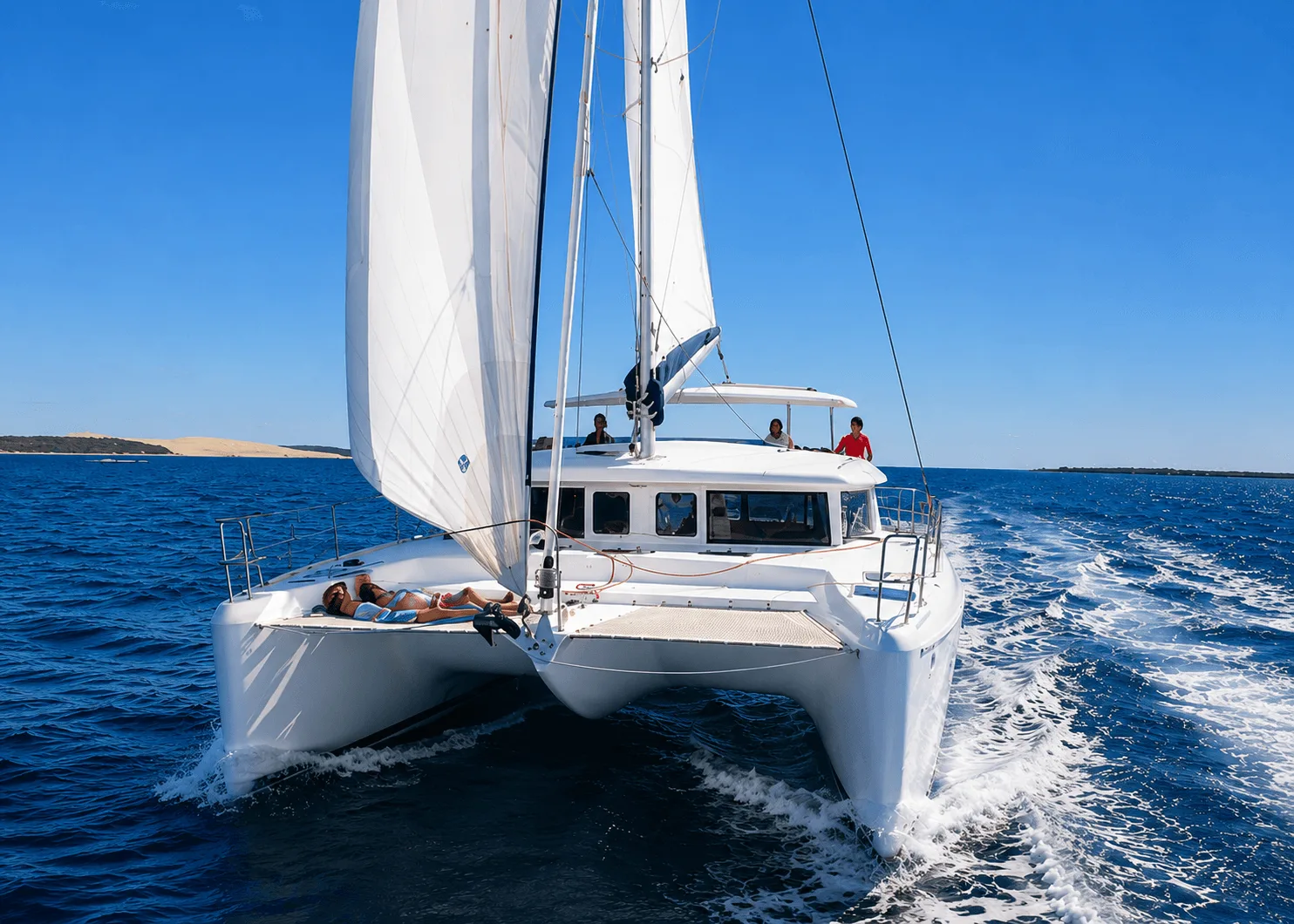
A certificate is the start, not the end. The responsibilities that come with a bareboat, from the handover and the deposit to the daily checks, are set out in what a bareboat charter actually involves. If you are not sure you are ready, a professional skipper can be added to a bareboat booking.
How long it takes
From no experience to a skipper’s certificate takes at least ten days on the water: five days aboard before the Day Skipper course and five days on it, plus the theory in between.
| Course | Length | Experience needed first | What it covers |
|---|---|---|---|
| Start Yachting | 2 days | None | Steering under power, raising the sails, handling ropes |
| Competent Crew | 5 days | None | Steering, changing sails, reefing, knots, safety, living aboard |
| Day Skipper practical | 5 days | 5 days, 100 miles and 4 night hours aboard, plus Day Skipper theory | Taking charge of a 30 to 45 ft yacht and its crew on day trips in familiar waters |
The Day Skipper practical is designed for a useful crew member with some theory knowledge, which is what a Competent Crew week sets out to produce. The theory course is recommended before the practical one, so that the navigation you learn on paper can be used on the water.
A skippered week fits anywhere in that path. Before a course it tells you whether you like the life. Between the two practical courses it adds days and miles at sea with a professional alongside. After the Day Skipper it is a calm way to sail a new area for the first time.
Frequently Asked Questions
How easy is it to learn to sail?
The basics fit into a week. A beginner course such as Competent Crew teaches steering, sail handling and knots in five days with no previous experience. Becoming a skipper takes longer, because the Day Skipper course expects time at sea and theory knowledge before it starts.
Can I sail with no experience?
Yes, on a skippered charter, where a professional sails the yacht and nobody in your group needs a licence or experience. If you want to learn, the skipper will let you take part and teach you the basics during the trip.
Can you do the RYA Day Skipper course in Greece?
Yes. The Royal Yachting Association’s list of training centres includes one on Aegina, in the Saronic Gulf, that runs the Day Skipper practical course.
What is the Competent Crew course?
It is the Royal Yachting Association’s practical course for beginners who want to become active crew. It lasts five days, needs no previous experience and is taught on board, covering steering, changing sails, reefing, knots and safety.
Sources
- Royal Yachting Association, Competent Crew Practical Course. https://www.rya.org.uk/course-finder/competent-crew-practical-course/
- Royal Yachting Association, Day Skipper Practical Sailing course. https://www.rya.org.uk/course-finder/day-skipper-practical-sailing/
- Royal Yachting Association, Start Yachting Course. https://www.rya.org.uk/course-finder/start-yachting-course/
- Royal Yachting Association, Sail Cruising Courses. https://www.rya.org.uk/training/sail-cruising-courses/
- Royal Yachting Association, Where’s my nearest: Aegean Sailing School. https://www.rya.org.uk/wheres-my-nearest/aegean-sailing-school/
Send us your dates, the size of your group and how much sailing anyone has done, and we will come back with the skippered or bareboat yachts that suit your week.
Send your dates for a skippered or bareboat quote